See Whale-Sized Flow The Moment It Hits
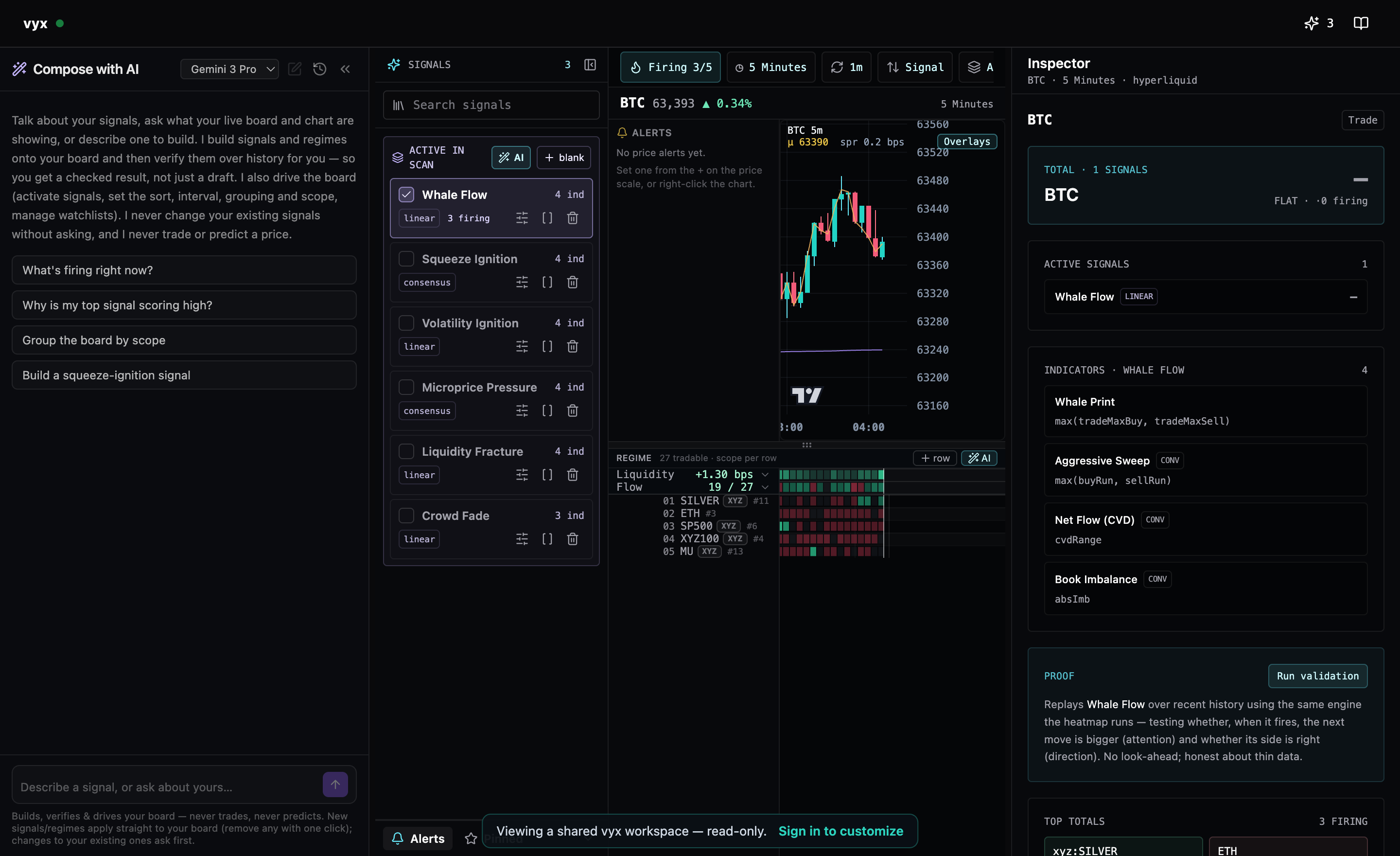
VYX turns the Hyperliquid order book and trade tape into one live board, scored for large-order activity across 300+ markets. The Whale Flow trade desk below ranks every market by the size moving it right now — the biggest prints, the most aggressive sweeps, and the net flow behind them — so the markets a big player is actually pushing rise to the top.
What Counts As A "Whale" On Hyperliquid
A whale is not a name on a leaderboard — it is size in the flow. Big players leave four readable footprints, and each is a built-in VYX signal you can open and study:
- A whale print — one oversized market order that lifts a stack of offers or hits a stack of bids in a single trade.
- An aggressive sweep — a fast run of same-side market orders tearing through several price levels of resting liquidity.
- Absorption — the opposite tell: heavy aggressive flow the book quietly soaks up without moving price, the mark of a big passive player defending a level.
- Net flow (CVD) — the running balance of aggressive buying minus selling, which confirms whether the prints and sweeps add up to real one-sided pressure.
Reading Whale Activity: A Worked Example
Say BTC grinds into a prior high and a burst of buying prints — Whale Print and Aggressive Sweep both light up and CVD spikes. Two things can happen next, and the board tells them apart. If price breaks and holds, the size was initiating: real demand taking the level. If price stalls while CVD keeps climbing, that buying is being absorbed — a larger passive seller is filling every market buy without giving ground, often the tell before a fade. A position tracker shows neither in time; the flow shows both as they happen.
Why Order Flow Beats A Position Snapshot
Wallet and leaderboard trackers refresh every few seconds to once a day and show positions after they appear on-chain. Order flow is live and earlier: a sweep or whale print shows a big player hitting the book as it happens — seconds before a position snapshot updates. It also catches what no position tracker can — absorption, where a whale defends a level passively and never opens a trackable position — and it spans the whole venue, so unusual size on a market no leaderboard covers still surfaces.
Whale Flow vs. Wallet Tracking
They answer different questions, and they pair well. An on-chain explorer answers "who is this wallet and what do they hold." VYX answers "is a big player moving this market right now, and how is it being absorbed." VYX reads market microstructure — price, size, and flow — so it works the instant size hits the tape, across every market, including the ones no whale leaderboard covers. Use an explorer for identity; use VYX for impact.
FAQ
How does VYX track whales on Hyperliquid?
It reads the live order book and trade tape across 300+ markets and scores large-order activity — the biggest prints (Whale Print), the most aggressive sweeps, and absorption — so the markets a big player is moving rise to the top. It reads market microstructure (price, size, flow) rather than on-chain wallet identity, so pair it with an explorer when you need to know who a specific wallet is.
How does VYX detect whale activity without tracking wallets?
From the order book and trade tape. A whale leaves a microstructure footprint — an oversized taker print (Whale Print), a long one-sided run of aggressive trades (Aggressive Sweep), or aggression being absorbed by a heavy opposite book. VYX turns each into a signal and ranks every market by it in real time.
How is this different from a Hyperliquid whale leaderboard or whale-alert bot?
Leaderboards and alert bots report positions after they appear on-chain — who holds what, who is up. VYX reports flow as it happens — whether big size is moving this market right now. It is earlier, it works across all 300+ markets, and it catches absorption, which leaves no position for a tracker to see.
What is order absorption, and why can position trackers not see it?
Absorption is a large passive player soaking up aggressive flow — for example, filling every market sell without letting price drop. Because they rest on limit orders instead of opening an aggressive position, there is no position-change event to track; it shows only as CVD rising while price stalls. That microstructure tell is exactly what VYX surfaces.