The Internals Crypto Never Had
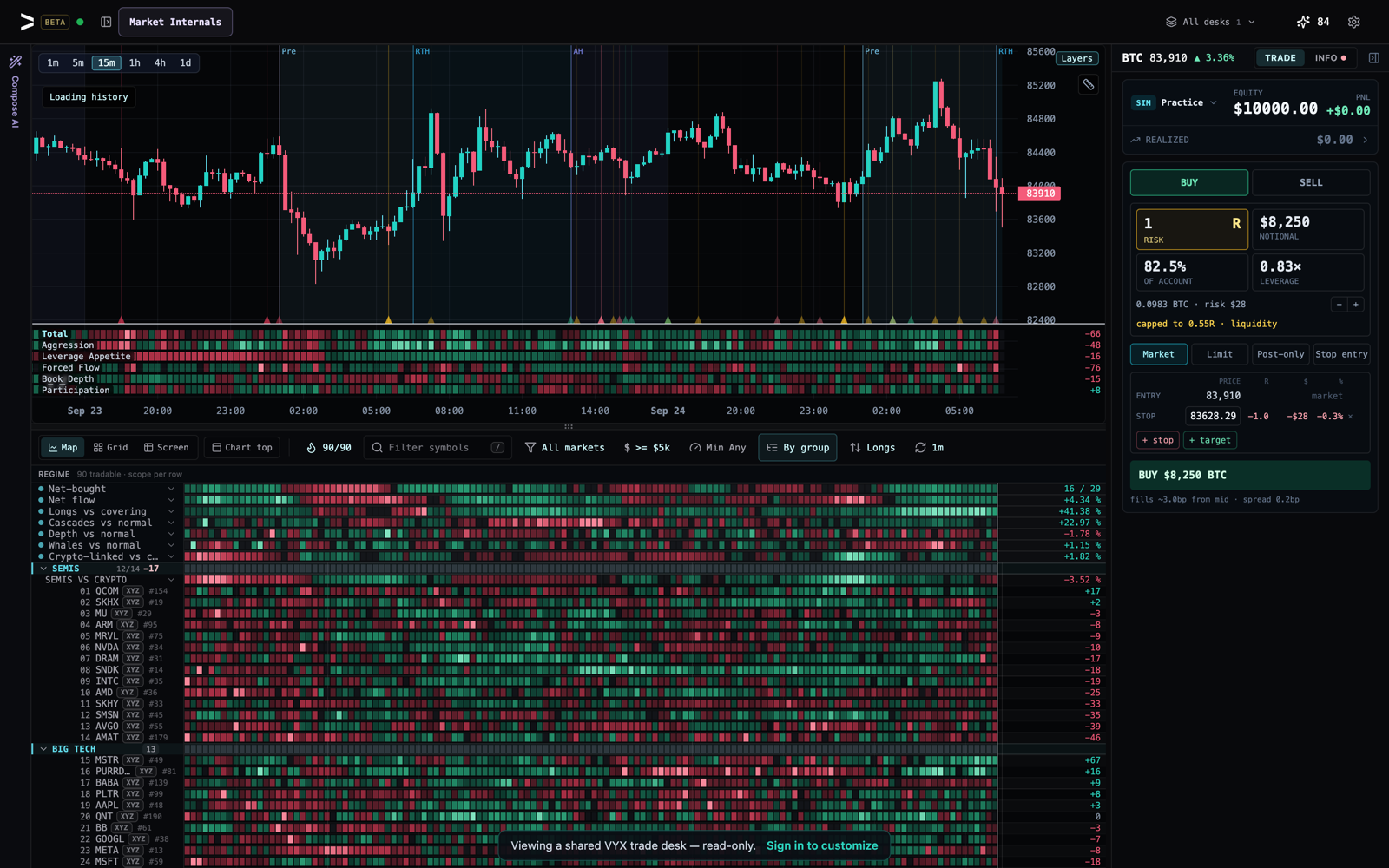
Equity traders have read market internals for decades — TICK, advance-decline, up-volume against down-volume — because an index can rise on a handful of names while the rest of the market sells. Crypto never had them: nobody scored the whole venue’s tape, perps and order book every bar. VYX does. The Market Internals trade desk reads every Hyperliquid market and reduces it to a handful of rows you can take in at a glance, with the history of each painted beside it so you can see when it turned.
What The Desk Reads
Six rows describe the crypto field, each read the same way every bar so they can be compared over time:
- Net-bought — how many coins saw more aggressive buying than selling over the last twelve bars. Above half is a market being lifted; below half is one being hit.
- Net flow — the middle coin’s net aggressive buying as a share of everything it traded. It tells you how hard, where net-bought tells you how broad.
- Longs vs covering — of the coins that are rising, whether more are rising with open interest building (new longs) or falling (shorts buying back).
- Cascades vs normal — how hard same-side bursts of forced flow are hitting the tape against each coin’s own normal.
- Depth vs normal — how much resting liquidity the books hold against their own normal. Thin books move further on less.
- Whales vs normal — how much of the volume each coin’s recurring large traders (the wallets that have been among its biggest aggressors over the last 30 bars) are carrying against their own normal.
Who Is Being Bought, Not Just Who Went Up
Under the market-wide rows, the board is grouped into cohorts — majors, L1s, L2s, DeFi, memes, AI, payments and more — and each cohort carries its own row: its net buying minus crypto’s. A cohort above zero is being bought harder than the market; below zero, it is being sold into. Because every row is measured against crypto rather than the whole venue, the stock market’s day never flips a crypto cohort’s sign. Each market inside a cohort is scored on five reads of its own: Aggression, Leverage Appetite, Forced Flow, Book Depth and Participation — who is behind the flow.
Reading Internals Against Price: A Worked Example
Say the market is up on the day and the Market Sentiment desk reads risk-on. Open Market Internals. If most coins are net-bought, net flow is positive and the rising coins are rising on new longs, the move has buyers behind it — demand is taking the market higher. If instead the field is net-sold and the rising coins are rising while open interest falls, the rally is shorts covering: it runs until the covering is done. Add cascades running hot and books thinning out, and the move is fragile in either direction. Price alone reads the same in both cases; the internals do not.
FAQ
What are market internals?
Market internals are readings taken across every market at once — how many are rising, how many are being bought, how much volume is going up against down — rather than the price of one index. They show whether a move is broad or carried by a few names, and whether it has buyers behind it. VYX brings them to crypto by reading the tape, perps and order book of every Hyperliquid market each bar.
How can you tell short covering from new buying?
Watch open interest alongside price. A market rising while open interest builds is opening new longs — fresh money. A market rising while open interest falls is shorts closing — they buy to exit, which lifts price without new demand. The Longs vs covering row counts both across crypto and reports the difference.
What is crypto market breadth?
Breadth is how much of the market is taking part in a move. VYX measures it on order flow rather than just price: the share of coins where aggressive buying has beaten aggressive selling over the last twelve bars. A rally with narrow breadth is carried by a few coins; one with broad breadth has the market behind it.
Can you see what large traders are doing on Hyperliquid?
Their footprint in the flow, yes. Hyperliquid’s public trade feed names the wallet on each side of every trade, so VYX attributes each aggressive trade to the wallet that took it and measures, every bar, how much of the volume comes from the wallets that have been a market’s biggest aggressors recently, how many distinct wallets are trading, and whether a single wallet is carrying the bar. It shows participation, not positions — for what a specific wallet holds, use an on-chain explorer.
Does VYX show liquidations on Hyperliquid?
Hyperliquid does not publish a market-wide liquidation feed, so VYX reads forced flow from the tape instead: cascades, the bursts of same-side trades that liquidations and stop runs leave behind, scored against each market’s own normal.